Wednesday, October 26, 2016

Dewey Decimal Signs


1000+ ideas about Dewey Decimal Signs on Pinterest | Decimal ...

https://www.pinterest.com/explore/dewey-decimal-signs/
Dewey Decimal Library Classification | Virtual Learning Space / Dewey Decimal ..... Poster Pack can be displayed in your LMC or classroom library for students.
https://www.pinterest.com/explore/dewey-decimal-signs/

Friday, October 14, 2011

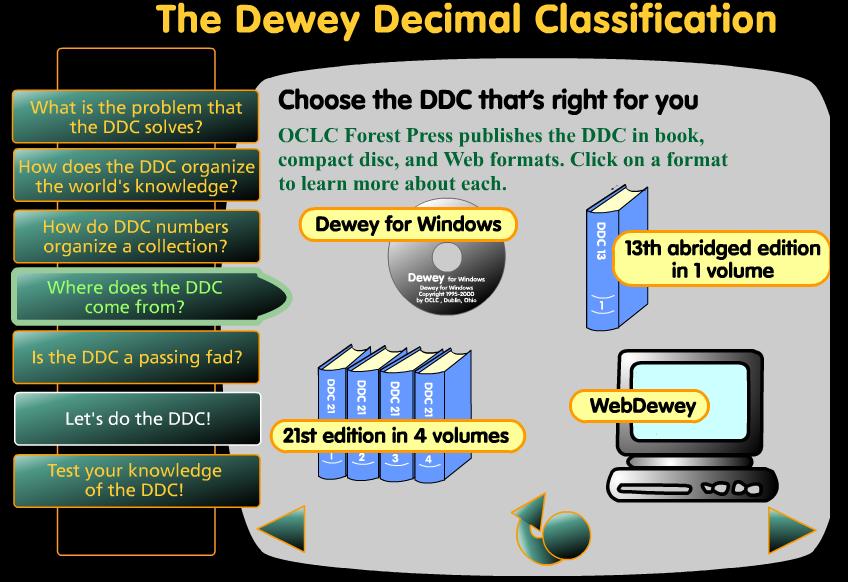
Choose the DDC that's right for you


Most librarians who start to do cataloguing using DDC, may find the advice from OCLC useful.

Go to this page, and select "Take the animated tour"
http://www.oclc.org/dewey/resources/tour/default.htm

When you have the animated tour, choose the fourth "Green" Tag on the left "Where does the DDC come from?", and page through the introductory slide, you will find it on the second slide.

With the help of this slide and the subsequent links it offered, you will be able to explore and visit web sites that give you full details of:

*Dewey for windows

*13th Abridged Edition in 1 volume

*21st Edition in 4 volumes

*WebDewey

Selecting the right DDC to start with is not difficult, if you are attentive enough.

If you like to have some one guiding your school librarians, just email

Dexterine Ho at

dexterine@yahoo.com
or
smho@e.ntu.edu.sg

You may like to visit:

List of schools with in-house workshops conducted by Dexterine Ho via INNO HANDS-ON
http://innoworkshop.blogspot.com/2011/06/list-of-schools-with-in-house-workshops.html

Courses from INNO HANDS-ON
http://innoworkshop.blogspot.com/

For course related to DDC, you may browse this blog or email her for other courses available.

If you have any special themes and requirements, Dexterine Ho will be glad to help you to plan and conduct a workshop that meets the special needs!

Thursday, October 13, 2011

Animated tour of DDC

Nowadays, it is animation that capture the attention of the learners!

Visit and follow OCLC Animated tour of DDC, you will learn how you can use DDC to organize information on any topic under the sun.

http://www.oclc.org/dewey/resources/tour/default.htm

If you are innovative enough, you will get some good ideas to create library display and highlight your library collection using DDC numbers, DDC subject groupings, DDC's tree of knowledge.

Plunking the fruits of DDC is not difficult, if you are attentive enough.

If you like to have some one guiding your school librarians, just email

Dexterine Ho at

dexterine@yahoo.com
or
smho@e.ntu.edu.sg

You may like to visit:

List of schools with in-house workshops conducted by Dexterine Ho via INNO HANDS-ON
http://innoworkshop.blogspot.com/2011/06/list-of-schools-with-in-house-workshops.html

Courses from INNO HANDS-ON
http://innoworkshop.blogspot.com/

For course related to DDC, you may browse this blog or email her for other courses available.

If you have any special themes and requirements, Dexterine Ho will be glad to help you to plan and conduct a workshop that meets the special needs!

Monday, October 10, 2011

DDC System: An Overview

Many of my LAS WSQ trainees who are support staff from academic libraries in Singapore find DDC hard to understand.

After running LAS WSQ Module 5 Support Bibliographic Control twice this year, I think there is a need to make DDC relevant to anyone who has an interest in DDC library classification system.


Dewey Decimal Classification (DDC) System

DDC is used in more than 200,000 libraries, mainly public or school libraries throughout the world and it has been translated into 35 languages.

The Dewey decimal system, using numbers and letters, coordinates materials on the same subject and on related subjects to make items easier to find on the shelves.

All knowledge is divided into ten main classes, which are listed below

000 Generalities

100 Philosophy and Psychology

200 Religion

300 Social Science

400 Language

500 Natural Science and Mathematics

600 Technology (Applied Sciences)

700 Arts

800 Literature

900 Geography and History


The ten main classes are then further subdivided.

Each main class has ten divisions, and each division has ten sections.

Hence the system can be summarized in 10 main classes, 100 divisions and 1000 sections.


To view the 10 main classes, 100 divisions and 1000 sections, go to

Dewey Decimal Classification, Wikipedia, the free encyclopedia at

http://en.wikipedia.org/wiki/List_of_Dewey_Decimal_classes#Classes

or

Download the DDC 22 Summaries (PDF format; 20 pages)

from OCLC at

http://www.oclc.org/dewey/resources/summaries/deweysummaries.pdf

If you like to train your support staff to do bibliographic control and other library tasks, you may like to enroll them for courses offered by Library Association of Singapore: http://www.las.org.sg/wp/training-development/for-support-staff/

If you like to give your teacher and student librarians some good understanding of Library Display with an introduction of DDC, you may visit
http://understandingddc.blogspot.com/2008/04/understanding-ddc-through-innovative.html

Dexterine Ho

Saturday, October 8, 2011

Understanding DDC through INNOvative Displays!


Understanding DDC through INNOvative Displays!

If you find learning or teaching Dewey Decimal Classification (DDC) difficult, try using display methods!


With INNO HANDS-ON, you can master display ideas for your school library the fun and INNOvative way!


Understandind Dewey Decimal Classification (DDC) can be fun and interesting!

Creating Library Displays can be fulfilling!

Let's Enjoy Creating Library Displays and Understanding DDC...
the INNO HANDS-ON way!

=============================
Understanding DDC through INNOvative Displays
=============================

COURSE DESCRIPTION

Having some DDC call numbers in your head will save you time, and you'll maintain your "Expert" status in front of library users.

This workshop will guide participants and enable them to understand Dewey Decimal Classification system.


In addition, they will have innovative hands-on experience to create eye-catching posters and 3 dimensional display illustrating DDC numbers that excites and stimulates their users.


Participants in this workshop will learn to recall 10 main classes with ease through innovative display.


After the hands-on workshop, you will be able to create attractive DDC number posters and 3 dimensional display in many ways.

Course fee: $90 per participant (Students' group)
Duration: 1 session of 6 hours, or 2 sessions of 3 hours each
Minimum: 25 participants
(Learning material will be provided)

Course fee: $120 per participant (Teachers' group)
Duration: 1 session of 6 hours, or 2 sessions of 3 hours each
Minimum: 20 participants
(Teaching materials will be provided)

Notes:
The courses will be conducted at participants' school


Course fee covers all materials used during the workshop and a Certificate of Attendance


INNO HANDS-ON
Business Registration No. 52903124L

Blk 81 Tiong Poh Road #01-47
Singapore 160081

For enquiries, email
dexterine@yahoo.com
or
smho@e.ntu.edu.sg

Tel: 9660 4692 (hp) Fax: 6220 8387


INNO HANDS-ON
Courses for teachers and students etc...

http://innoworkshop.blogspot.com/


About Dexterine Ho Soo Miang
BA (Hons), PG Lib (Wales), MLIS (Wisconsin)

Ms Dexterine Ho Soo Miang obtained her PG Dip in Librarianship from University of Wales (UK) and her Masters in Information Studies from University of Wisconsin (US).

Experience in Tertiary Institutions:

Head of Reader Services and Reference Department, National Institute of Education (NIE) Library 1982-1996

Lecturer & Adjunct Lecturer, Information Studies and IRBD (International Relations and Business Development), Temasek Polytechnic 1996-2000

Reference Librarian (Pt-time), Temasek Polytechnic 1998-2000

Adjunct Lecturer, Interdisciplinary Studies Dept, Ngee Ann Polytechnic 2001

Senior Assistant Director (Pt-time), Nanyang Technological University (NTU) Library 2001-2003

Adjunct lecturer (Digital Literacy Skills), National Institute of Education (NIE)2001-2007

As her skills in information retrieval and display works are now well recognized, she has been invited to conduct workshop in schools/ institutions and private organizations.

Currently, besides providing training and consultancy services through INNO HANDS-ON, she is ACTA certified trainer and assessor for LAS WSQ Level 2 Support Staff Training.

List of schools with in-house workshops conducted by Dexterine Ho through INNO HANDS-ON is available at:

http://innoworkshop.blogspot.com/2011/06/list-of-schools-with-in-house-workshops.html

Sunday, September 25, 2011

Dewey Decimal Hotlist for Librarians

If you run out of ideas on how to use DDC for library displays, you may like to use the following hotlist:

Dewey Decimal Hotlist for Librarians
An Internet Hotlist on The Dewey Decimal System

created by Linda Reilly
Plymouth Community Intermediate School Library

This librarian's list of links was created to classify Dewey Decimal information found on the Internet that could be used in teaching the Dewey Decimal System to students.

http://www.kn.att.com/wired/fil/pages/listthedeweli.html


If you do not have and budget to engage trainer to teach your students, this will be a good source for you to plan your lessons.


With the help of this organised source, your students will learn a lot from you and they will in return, contribute more and make your library an organised and attractive learning hub!

Saturday, June 25, 2011

Dazzling Kids With Dewey

Dazzling Kids With Dewey: Learning about the century-old classification system can be fun
By Shelley Riskin -- School Library Journal, 11/1/2003


Are your students more likely to doze off than be dazzled by Dewey decimal skills?


Don't despair, there are indeed engaging ways to teach kids how to use this century-old classification system to accurately and efficiently find library materials.

Click the following link to read the full text of the article:

http://www.schoollibraryjournal.com/article/CA332698.html

Plucking the fruits of DDC is not difficult, if you are attentive enough.

If you like to have some one guiding your school librarians, just email

Dexterine Ho at

dexterine@yahoo.com
or
smho@e.ntu.edu.sg

You may like to visit:

List of schools with in-house workshops conducted by Dexterine Ho via INNO HANDS-ON
http://innoworkshop.blogspot.com/2011/06/list-of-schools-with-in-house-workshops.html

Courses from INNO HANDS-ON
http://innoworkshop.blogspot.com/

For course related to DDC, you may browse this blog or email her for other courses available.

If you have any special themes and requirements, Dexterine Ho will be glad to help you to plan and conduct a workshop that meets the special needs!
Wednesday, June 8, 2011

Finding good slides on DDC

Slide Share at http://www.slideshare.net/ have a good collection of slides on DDC

Here is one of them:
http://www.slideshare.net/denisegaro603/dewey-classification

For more, just search

"Dewey Decimal"

in the search box!

With the ideas you get from the slides, plucking the fruits of DDC for Library Display or Classroom display is not difficult, if you are attentive enough.

If you like to have some one guiding your school librarians, just email

Dexterine Ho at

dexterine@yahoo.com
or
smho@e.ntu.edu.sg

You may like to visit:

List of schools with in-house workshops conducted by Dexterine Ho via INNO HANDS-ON
http://innoworkshop.blogspot.com/2011/06/list-of-schools-with-in-house-workshops.html

Courses from INNO HANDS-ON
http://innoworkshop.blogspot.com/

For course related to DDC, you may browse this blog or email her for other courses available.

If you have any special themes and requirements, Dexterine Ho will be glad to help you to plan and conduct a workshop that meets the special needs!

Tuesday, May 10, 2011

What is a call number?

For school librarians, it is important to know:

What is a call number ?

Every item in the library has its own address, the call number.

Fiction is shelved alphabetically by the author’s last name.

Non-fiction is shelved using a Dewey Decimal Classification number.

The Dewey decimal system groups materials on the same subject and on related subjects to make items easier to find on the shelves by using a combination of numbers and letters.

The Dewey system has ten main subject areas; each of these areas has ten divisions. These divisions are further divided--and then further divided.

Each division becomes more specific. The more numbers there are, the more specific the subject.

In this way, the Dewey classification system progresses from the general to the specific.

The final part of the non-fiction call number is often a letter/number code for the author or title, making the whole call number a unique identifier.

To learn more about DDC call number, visit the source of the above information at:

http://www.library.barrie.on.ca/research/tutorials/pdf/dewey.pdf

For libraries using cutter number for Author or Title code, please read the page:

"Let's Do Dewey-What is a call number?" at
http://www.mtsu.edu/~vvesper/dewey2.htm#What

Plucking the fruits of DDC is not difficult, if you are attentive enough.

If you like to have some one guiding your school librarians, just email

Dexterine Ho at

dexterine@yahoo.com
or
smho@e.ntu.edu.sg

You may like to visit:

List of schools with in-house workshops conducted by Dexterine Ho via INNO HANDS-ON
http://innoworkshop.blogspot.com/2011/06/list-of-schools-with-in-house-workshops.html

Courses from INNO HANDS-ON
http://innoworkshop.blogspot.com/

For course related to DDC, you may browse this blog or email her for other courses available.

If you have any special themes and requirements, Dexterine Ho will be glad to help you to plan and conduct a workshop that meets the special needs!

Thursday, June 25, 2009

Posters illustrating the Dewey decimal classification system

Library classification - a set of posters illustrating the Dewey decimal classification system, for display above the appropriate shelves. (Includes posters for returns and mending)

http://www.ti-lung.co.uk/Resources/library.pdf

Thursday, June 18, 2009

PPT files on Dewey Decimal System

I run an Advanced search on Google today and search "Dewey Decimal" with the file type set to "PPT", here is what I get:

Results 1 - 10 of about 1,110 for Dewey decimal filetype:ppt.

The first three are very useful to school librarians:

[PPT]
dewey decimal system
File Format: Microsoft Powerpoint - View as HTMLBy using something cool called The Dewey Decimal System !! The Dewey Decimal System is a tool used to sort books into. groups or. categories ...jc-schools.net/tutorials/PPT/DeweyDecimal.ppt - Similar pages


[PPT]
Get to know the Dewey Decimal Classification system
File Format: Microsoft Powerpoint - View as HTMLIt’s called the Dewey Decimal Classification system—or DDC. This system got its name from Melvil Dewey (1851-1931), who introduced his great idea for ...www.oclc.org/dewey/resources/tutorial/adults_tutorial_0606.ppt - Similar pagesMore results from www.oclc.org »

[PPT]
Dewey Decimal Classification System
File Format: Microsoft Powerpoint - View as HTMLThe Dewey Decimal Classification call number can be found on the spine label. Why? When the book is shelved, the Dewey Decimal Classification call number ...alex.state.al.us/uploads/15291/Dewey%20Decimal%20Classification%20System.ppt - Similar pages

Saturday, June 13, 2009

Test Your DDC Knowledge

Go to the following link and test your knowledge on Dewey Decimal Classification:

http://www.studystack.com/matching-471

Have fun!

Cheers!

Learn from library supplier

Dewey Decimal "Got Your Number" Displays

Use Dewey Subject displays to direct readers to specific areas in your library. Each illustration is accompanied by a subject and corresponding Dewey classification number.

Example of such application can be found at:

Demco.com Dewey Decimal Got Your Number Displays

http://www.demco.com/goto?BLK9330&STA0000

Under the search box, just type "Dewey" to search for more entries.

Monday, June 1, 2009

Hong Kong Central Library Children Collection DDC 800

I visited Hong Kong Central Library in July 2008 and like the way they design the DDC Call Number Display for their Children Collection.

Here is a photograph illustrating how DDC 800 classification number is being designed:


The Blue Dolphin DDC Classification Number Guides stand on top of the shelves imply that reading is like swimming in an ocean:

  • As dolphin is an intelligent mammal , he/she will guides you in navigating the DDC knowledge world systematically!
  • Follow the intelligent guide, searching for your ideal book will never like looking for a needle in a haystack!
  • Reading is like swimming in the ocean, it is full of joys and discovery!


Cheers!

Saturday, May 30, 2009

DDC 22 Print

DDC 22 Print: Four printed volumes help keep your collections organized

DDC 22, the four-volume unabridged edition of the Dewey Decimal Classification (DDC) system, reflects the many changes to the body of human knowledge that have occurred since DDC 21 was published in 1996.

Published in mid-2003, DDC 22 includes helpful tools that make the classification easier to use.

You can download PDF versions of DDC 22 highlights, including an introduction, a glossary and a list of new features.

Each of these tools will help you better understand how the DDC organizes knowledge into a classification that is useful to library users worldwide.

The DDC 22 Introduction (37 pages, 258K), a full reprint from volume 1 of DDC 22, provides a detailed overview of the DDC, including basic terminology and an explanation of DDC structure, complete with many helpful examples.

If you are new to classifying with Dewey, this introduction will help you get started quickly.

The Glossary (9 pages, 74K), also reprinted from volume 1 of DDC 22, provides helpful definitions of DDC terms and gives users a common language for implementing the DDC.

New Features (20 pages, 143K), another reprint from volume 1 of DDC 22, concisely describes what’s new in DDC 22, including changes implemented to enhance classifier productivity and a selected list of specific changes to DDC numbers. Look here if you want to quickly assess the changes from DDC 22 that you can apply to your collections.

If you like to download the PDF versions of DDC 22 highlights, including the Introduction (37 pages, 258K), the Glossary (9 pages, 74K), or the New Features (20 pages, 143K), just go to the source of information at this url:

http://www.oclc.org/dewey/versions/ddc22print/default.htm

Friday, May 29, 2009

How to Remember DDC

Here are some tools/websites to help you remember what each of the Dewey hundreds groups represents:

Play the Dewey Bookbody Game

The answer will appear below when you put the mouse over Dewey's different body parts.

http://www.patmillerbooks.com/kids.html


Dewey and the Alien

Learn about the Dewey Decimal system in a website designed by 6th graders...They are going to tell you how to remember what each of the Dewey hundreds represent.

http://http//library.thinkquest.org/5002/Alien/alien.htm


Dewey Decimal Web Quest


When you have finished this Quest you will know more about the Dewey Decimal System. Remember to try a Dewey-related game to test your knowledge.

Dewey Decimal System


File Format: Microsoft Powerpoint
Dewey Decimal System: This seems like a lot to remember, but don’t worry you’ll learn it all quickly.
http://www.floyd.k12.va.us/itrt/pwrpnts/library%20science/DeweyDecimal.pptlibrary%20science/DeweyDecimal.ppt

Friday, May 22, 2009

WebDewey: the Easiest Way to use DDC

The Easiest Way to use DDC is to use WebDewey.

WebDewey gives access to an enhanced version of the DDC database.

It is part of the OCLC suite of cataloging and metadata services that OCLC offers through the OCLC Connexion service.

Logon to WebDewey at http://connexion.oclc.org/

WebDewey includes:

  • all content from DDC 22, including quarterly updates ( new developments, new built numbers, and additional electronic index terms )
  • updated PPT mappings to Edition 22 numbers in the areas of computer science and law
  • thousands of Library of Congress Subject Headings (LCSH) that have been statistically mapped to Dewey numbers from records in WorldCat (the OCLC Online Union Catalog) and intellectually mapped by DDC editors
  • thousands of Relative Index terms and built numbers not available in print
  • links from mapped LCSH to the LCSH authority records
  • selected mappings from Medical Subject Headings (MeSH)

Using WebDewey: An OCLC Tutorial at

http://www.oclc.org/dewey/resources/tutorial/

to learn how WebDewey works


Source of information:
http://www.oclc.org/dewey/versions/webdewey/default.htm

Thursday, May 21, 2009

Understanding DDC (Dewey Decimal Classification)

"Understanding DDC Through INNOvative Display" is the title of this blog, and the main purpose of this blog is:

First step: to guide readers to understand DDC (Dewey Decimal Classification).

The
second step, is to use DDC (Dewey Decimal Classification) to create INNOvative display.

As this Blog is created to benefit school librarians who are either students or teachers in Singapore, it may not be useful for cataloguers who are expert users of DDC schedule.

Since the purpose of this blog is to guide school librarians in understanding DDC, in order to make the learning process fun and interesting, the core teaching is through INNOvative display.

The three Learning Goals are:
  • Understand DDC and enable learners to recall the main classes with ease
  • Enable learners to understand DDC's hierarchical structure and display DDC call numbers in logical, yet interesting and attractive manner
  • Understand the hierarchy of DDC and enable learners to recall DDC call numbers through INNOvative HANDS-ON experience


Tuesday, May 19, 2009

DDC Abridged Edition is suitable for school libraries

For libraries with collections of 20,000 titles or fewer, the abridged edition of the Dewey Decimal Classification (DDC) system provides the level of detail needed to classify the materials in those collections.

Abridged Edition 14, published in early 2004, reflects the many changes to the body of human knowledge that have occurred since Abridged Edition 13 was published in 1997.

Packaged in one convenient, affordable print volume, the abridged DDC provides Dewey numbers that are compatible with the unabridged edition should a library’s collection expand and require deeper classification detail.

Source of information:
http://www.oclc.org/dewey/versions/abridgededition14/